TOPICS
DATE
August 20, 2026
SHARE
August 20, 2026

Heatstroke-Related Ambulance Transports in Tokyo Vary by Day Type Beyond the Effects of Heat

Dr.Yuji Nishiwaki
A research group from the Department of Environmental and Occupational Health and the Department of Community Well-Being, Faculty of Medicine, Toho University, analyzed heatstroke-related ambulance transport data in Tokyo from 2015 to 2025. The study found that, even after adjusting for the Wet Bulb Globe Temperature (WBGT), the occurrence of heatstroke varied between weekdays, weekends/holidays, and post-holiday weekdays. These differences were particularly pronounced among older adults and children, indicating that behavioral patterns associated with specific days of the week may contribute to heatstroke risk. The findings emphasize the need to incorporate behavioral and social factors, in addition to meteorological conditions, into heatstroke prevention strategies.
Dr.Yuji Nishiwaki
A research group from the Department of Environmental and Occupational Health and the Department of Community Well-Being, Faculty of Medicine, Toho University, analyzed heatstroke-related ambulance transport data in Tokyo from 2015 to 2025. The study found that, even after adjusting for the Wet Bulb Globe Temperature (WBGT), the occurrence of heatstroke varied between weekdays, weekends/holidays, and post-holiday weekdays. These differences were particularly pronounced among older adults and children, indicating that behavioral patterns associated with specific days of the week may contribute to heatstroke risk. The findings emphasize the need to incorporate behavioral and social factors, in addition to meteorological conditions, into heatstroke prevention strategies.
Print
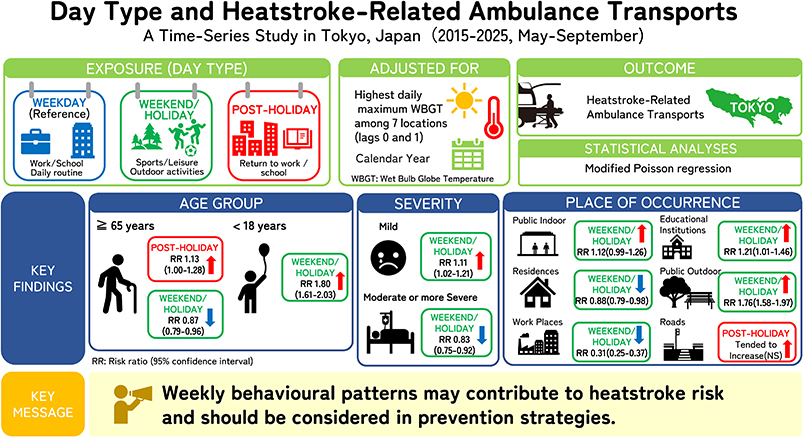
The figure shows differences in heatstroke-related ambulance transports by day type in Tokyo after adjustment for WBGT, with distinct patterns according to age, severity, and place of occurrence. Credit: Nishiwaki Y, Mori S, Michikawa T. / Environmental Health and Preventive Medicine, 2026, CC BY
Key Points
  • Analysis of 11 years (2015-2025) of heatstroke-related ambulance transport data in Tokyo revealed, for the first time, that heatstroke occurrence patterns differ by day type, even after adjusting for WBGT.
  • Among adults aged 65 years and older, heatstroke-related ambulance transports were 13% higher on post-holiday weekdays than on regular weekdays (RR = 1.13). By contrast, among individuals under 18 years of age, transports were 80% higher on weekends and holidays (RR = 1.80).
  • Distinct patterns also emerged regarding severity and place of occurrence, suggesting that behavioral factors associated with work, school, sports, and leisure activities may influence heatstroke risk.
  • The findings indicate that heatstroke prevention efforts should consider not only weather conditions such as WBGT but also age-specific and day-specific behavioral patterns to enhance the effectiveness of public health interventions.
Journal:
Environmental Health and Preventive Medicine (2026), Vol. 31, Article 51Title: Day type and heatstroke-related ambulance transports in Tokyo, Japan: a time-series study

Authors:
Yuji Nishiwaki, Sachie Mori, Takehiro Michikawa

DOI:
10.1265/ehpm.26-00077

READ MORE RESEARCH NEWS - MEDICINE

@ Toho University