Research Background and Findings
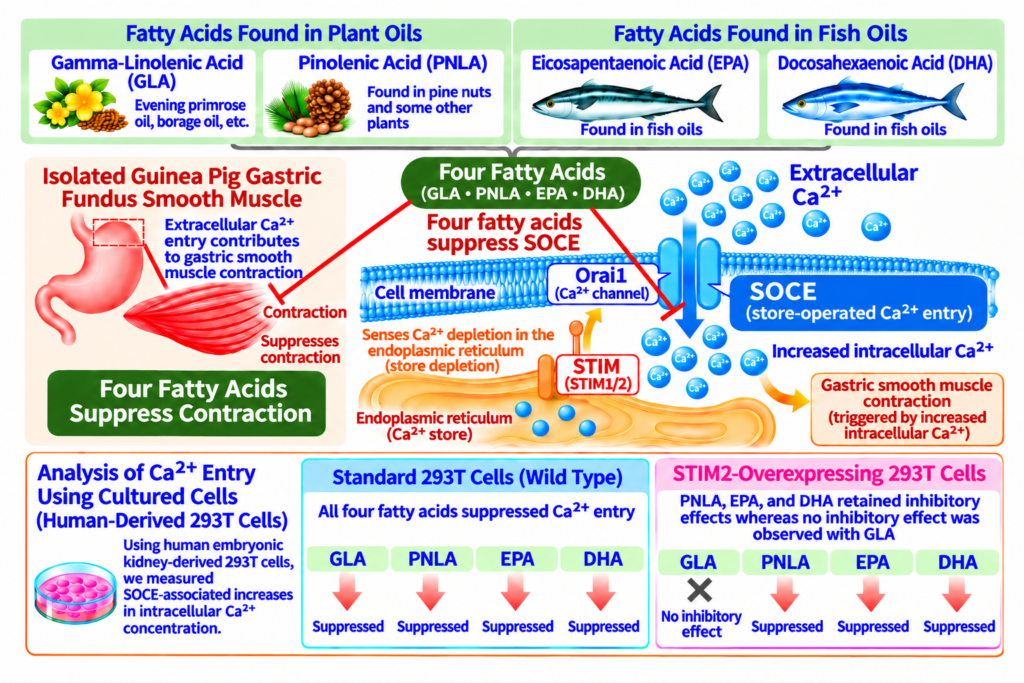
The stomach temporarily stores food and moves it toward the intestine through coordinated contraction and relaxation of smooth muscle in its wall. Ca2+ plays an essential role in regulating these movements. When Ca2+ stored inside cells, particularly in the endoplasmic reticulum, becomes depleted, proteins called stromal interaction molecules (STIMs) detect this decrease. They then promote Ca2+ entry from outside the cell through channels formed by Orai1 proteins in the cell membrane. This mechanism, known as store-operated calcium entry (SOCE), contributes to smooth muscle contraction.
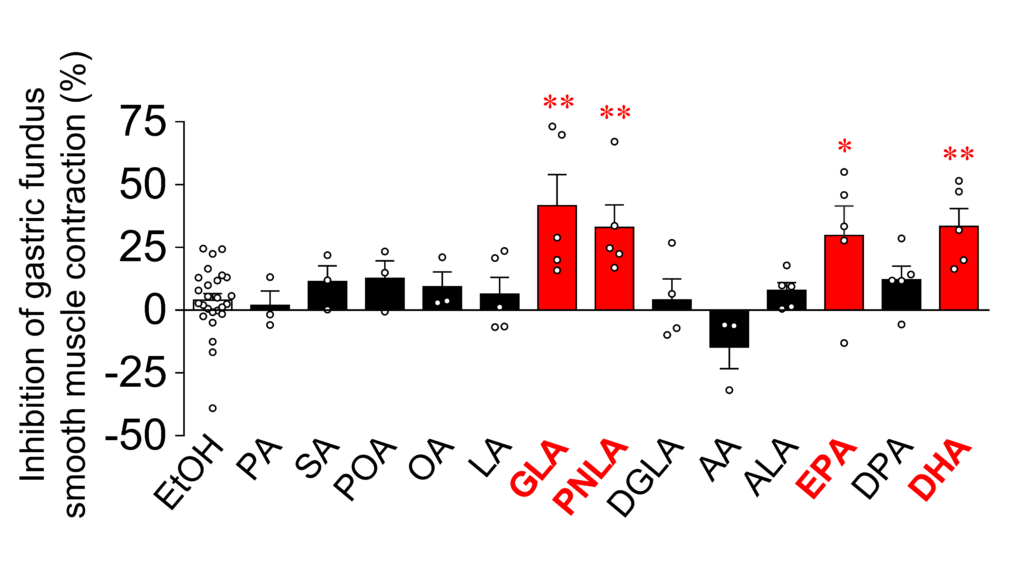
The research team previously demonstrated that DHA, an omega-3 fatty acid found in fish oils, inhibits SOCE-dependent contraction in guinea pig gastric fundus smooth muscle. However, it remained unclear whether this effect was specific to DHA or shared by other fatty acids. To address this question, the researchers compared 13 fatty acids with different chemical structures.
First, the researchers examined gastric fundus smooth muscle isolated from guinea pigs. Sustained contraction was induced using cyclopiazonic acid (CPA), a compound that reduces intracellular Ca2+ stores. Under experimental conditions in which other major Ca2+ entry pathways were pharmacologically suppressed, four fatty acids—GLA, PNLA, EPA, and DHA—significantly inhibited contraction (Figures 1 and 2). The remaining nine fatty acids showed no significant inhibitory effects under the same conditions.
Next, the researchers investigated Ca2+ entry using 293T cells, a human-derived cell line widely used to study intracellular signaling and Ca2+ regulation. All four fatty acids suppressed the increase in intracellular Ca2+ levels associated with SOCE. Pharmacological inhibition of Orai1 also markedly reduced Ca2+ entry. Together, these findings support the possibility that inhibition of Orai1-mediated SOCE contributes to the suppressive effects of these fatty acids on gastric fundus smooth muscle contraction.
To examine whether the cellular environment influences these effects, the researchers used 293T cells engineered to overexpress STIM2, a protein involved in regulating SOCE. In these cells, PNLA, EPA, and DHA continued to suppress SOCE-associated Ca2+ entry, whereas GLA no longer showed an inhibitory effect. These findings suggest that the inhibitory effects of fatty acids can vary depending on the cellular environment.
Taken together, these findings demonstrate that the ability to suppress SOCE-related responses is not unique to DHA but is also shared by GLA, PNLA, and EPA.
However, this study was conducted using isolated guinea pig stomach muscle and human-derived cultured cells. It does not establish that consuming these fatty acids through food or supplements alters stomach motility or improves any disease in humans.
Further investigation into how these fatty acids affect intracellular Ca2+ regulation and how they act in living organisms may provide a deeper understanding of the role of fatty acids in smooth muscle function.