TOPICS
DATE

October 22, 2026

SHARE

October 22, 2026

Plant-Derived Gamma-Linolenic Acid Found to Suppress Contraction of a Major Artery Supplying the Brain

— Findings Suggest TP Receptor Antagonism and Potassium Channel Activation —

Dr.Kento Yoshioka
A research team from the Department of Chemical Pharmacology, Faculty of Pharmaceutical Sciences, Toho University, has discovered that gamma-linolenic acid (GLA), a naturally occurring fatty acid found in plant oils, inhibits contraction of the basilar artery, a major blood vessel supplying the brain. Excessive contraction of this artery can reduce blood flow to the brain, potentially contributing to cerebral ischemia. Experiments using isolated pig basilar arteries demonstrated that GLA suppresses vascular contraction. Pharmacological analyses suggested that this effect involves TP receptor antagonism and may also involve activation of Ba2+-sensitive potassium (K+) channels. These findings provide new insights into how GLA affects cerebral blood vessels and may contribute to future research on maintaining healthy blood flow to the brain. The study was published in Biological and Pharmaceutical Bulletin on September 4, 2026.
Dr.Keisuke Obara
A research team from the Department of Chemical Pharmacology, Faculty of Pharmaceutical Sciences, Toho University, has discovered that gamma-linolenic acid (GLA), a naturally occurring fatty acid found in plant oils, inhibits contraction of the basilar artery, a major blood vessel supplying the brain. Excessive contraction of this artery can reduce blood flow to the brain, potentially contributing to cerebral ischemia. Experiments using isolated pig basilar arteries demonstrated that GLA suppresses vascular contraction. Pharmacological analyses suggested that this effect involves TP receptor antagonism and may also involve activation of Ba2+-sensitive potassium (K+) channels. These findings provide new insights into how GLA affects cerebral blood vessels and may contribute to future research on maintaining healthy blood flow to the brain. The study was published in Biological and Pharmaceutical Bulletin on September 4, 2026.

Key Points

  • GLA, an omega-6 fatty acid found in plant oils, was found to inhibit contraction of isolated pig basilar arteries.
  • GLA suppressed vascular contraction by antagonizing prostanoid TP receptors, which are involved in blood vessel constriction.
  • GLA also inhibited contraction through a mechanism that may involve activation of barium-sensitive K+ channels.
  • These findings may help advance research into the potential protective effects of GLA on cerebral blood vessels.

Research Background and Findings

The basilar artery supplies blood to vital regions of the brain, including the brainstem. Excessive contraction of this artery can narrow the blood vessel and reduce blood flow to the brain. Therefore, understanding the mechanisms that regulate vascular contraction is important for investigating cerebrovascular disorders.

GLA is an omega-6 polyunsaturated fatty acid found in plant oils such as evening primrose oil and borage oil. The research team previously demonstrated that GLA inhibits TP receptor-mediated contraction in coronary arteries, which supply blood to the heart. However, its effects on cerebral arteries remained unclear.

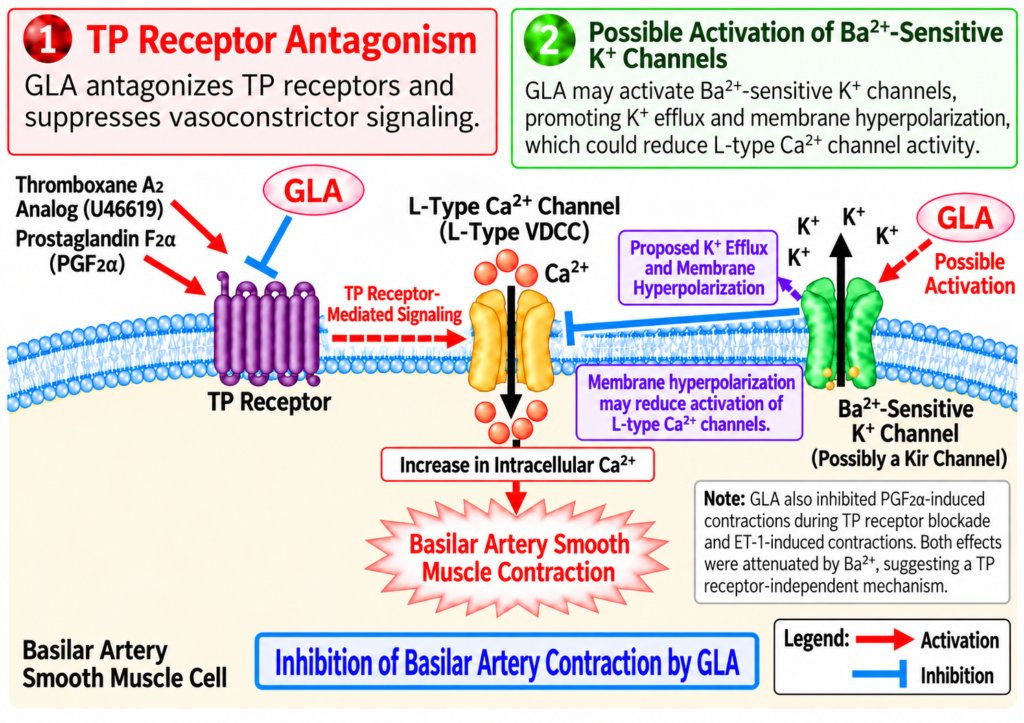
In the present study, the researchers investigated the effects of GLA on isolated pig basilar arteries. GLA inhibited contractions induced by U46619, a selective TP receptor agonist, and prostaglandin F2α (PGF2α). Pharmacological analysis suggested that GLA acts as an antagonist of the TP receptor.

Interestingly, GLA also inhibited contractions induced by PGF2α even when TP receptors were blocked. Furthermore, it suppressed contractions induced by endothelin-1 (ET-1), another potent vasoconstrictor. These findings suggest that GLA also acts through mechanisms independent of TP receptor antagonism. In contrast, GLA had no apparent effect on contractions induced by high extracellular K+, suggesting that direct inhibition of voltage-dependent Ca2+ channels is unlikely to be a major mechanism.

To investigate these additional mechanisms, the researchers examined the involvement of K+ channels, which regulate vascular smooth muscle activity. They found that barium ions (Ba2+), which block certain types of K+ channels, attenuated the inhibitory effects of GLA on PGF2α-induced contractions during TP receptor blockade and on ET-1-induced contractions. These findings suggest that activation of Ba2+-sensitive K+ channels, potentially including inwardly rectifying potassium (Kir) channels, contributes to the TP receptor-independent inhibitory effects of GLA.

Taken together, the findings suggest that GLA inhibits basilar artery contraction through TP receptor antagonism and possible activation of Ba2+-sensitive K+ channels (Figure 1).

However, because the experiments were performed using isolated pig arteries, further studies are needed to determine whether dietary intake of GLA can improve cerebral blood flow or help prevent cerebrovascular disorders in humans.


Journal:
Biological and Pharmaceutical Bulletin

Publish Date:
September 4, 2026

Volume and pages:
Vol. 49, No. 8, pp. 1298–1301

Article title:
γ-Linolenic Acid Inhibits Contractile Responses in Pig Basilar Arteries via Prostanoid TP Receptor Antagonism and Ba²⁺-Sensitive K⁺ Channel Activation

Authors:
Kento Yoshioka, Minami Inagaki, Tam Minh Phi, Haruki Kimura, Keigo Osa, Keisuke Obara, Noritaka Nakamichi, Yoshio Tanaka

DOI:
10.1248/bpb.b26-00185

Article URL:
https://doi.org/10.1248/bpb.b26-00185

Figure 1. Proposed Mechanisms Underlying the Inhibitory Effects of GLA on Basilar Artery Contraction
GLA may suppress basilar artery contraction through TP receptor antagonism and possible activation of Ba2+-sensitive K+ channels. Kir channels and subsequent membrane hyperpolarization may contribute to the latter mechanism.

READ MORE RESEARCH NEWS - Pharmaceutical Sciences

@ Toho University