September 9, 2026
— The Ca2+ Channel Orai1 May Play a Key Role in Disease-Associated Bladder Contraction —

A research team from the Department of Chemical Pharmacology, Faculty of Pharmaceutical Sciences, Toho University, has found that the calcium (Ca2+) channel Orai1 plays an important role in bladder contraction induced by platelet-activating factor (PAF) (Note 1), a bioactive lipid mediator involved in inflammation and allergic responses. Orai1 (Note 2) is a Ca2+ channel that mediates Ca2+ entry into cells.
In experiments using guinea pig urinary bladder smooth muscle, PAF-induced contraction was markedly suppressed by inhibition of Orai1. In contrast, Orai1 inhibition had only limited effects on contractions induced by acetylcholine (ACh) and adenosine triphosphate (ATP), major neurotransmitters involved in normal bladder function. PAF-induced contraction was also strongly suppressed by inhibition of L-type voltage-dependent Ca2+ channels (VDCCs) (Note 3). Together, these findings suggest that Orai1 plays a greater role in PAF-induced contraction associated with pathological conditions than in contractions involved in normal bladder function, and that Orai1-mediated Ca2+ entry may be functionally associated with VDCC-dependent contractile mechanisms.
These findings suggest that the contribution of Orai1 to bladder smooth muscle contraction differs depending on the stimulus. Further studies using disease models may help clarify the mechanisms underlying abnormal bladder contraction and identify new pharmacological targets.
The study was published in Biological and Pharmaceutical Bulletin on August 25, 2026.


Key Points
・The study identified the Ca2+ channel Orai1 as an important contributor to the mechanism by which PAF, a mediator involved in inflammation and allergic responses, induces bladder contraction.
・PAF-induced contraction of urinary bladder smooth muscle was strongly suppressed by Synta66, an Orai1 inhibitor (Note 4), whereas its effects on ACh- and ATP-induced contractions associated with normal bladder function were limited. These findings suggest that Orai1 may play a greater role in PAF-induced contraction associated with pathological conditions.
・PAF-induced contraction was also strongly suppressed by inhibition of L-type VDCCs, suggesting that Orai1-mediated Ca2+ entry may be functionally associated with VDCC-dependent contractile mechanisms. These findings may help advance our understanding of abnormal bladder contraction and identify new pharmacological targets.
Research Background and Findings
The urinary bladder stores urine and expels it during urination through contraction of the smooth muscle in the bladder wall. Ca2+ influx from outside the cell plays an important role in urinary bladder smooth muscle contraction. Ca2+ can enter smooth muscle cells through several pathways, with voltage-dependent Ca2+ channels (VDCCs) representing one of the major routes. In urinary bladder smooth muscle, Ca2+ influx through L-type VDCCs plays a particularly important role in contraction.
Platelet-activating factor (PAF) is a bioactive lipid originally identified for its ability to activate platelets. It is now recognized as an important lipid mediator produced by various cell types and involved in inflammation and allergic responses. PAF has been implicated in anaphylaxis and a range of inflammatory and allergic conditions and exerts diverse biological effects, including smooth muscle contraction.
The research team previously reported that PAF strongly contracts guinea pig urinary bladder smooth muscle and enhances spontaneous contractile activity. They also demonstrated that extracellular Ca2+ influx is essential for this response and that L-type VDCCs constitute a major Ca2+ entry pathway. However, because part of the PAF-induced response persisted even after inhibition of L-type VDCCs, the researchers hypothesized that additional Ca2+ entry pathways might also contribute to PAF-induced bladder contraction.
In the present study, the researchers focused on store-operated Ca2+ entry (SOCE) (Note 5), a mechanism by which extracellular Ca2+ enters cells when Ca2+ stores in the endoplasmic reticulum are depleted. Orai1 is one of the principal Ca2+ channels involved in this process. Using Synta66, an Orai1 inhibitor, the team investigated the contribution of Orai1 to PAF-induced contraction of urinary bladder smooth muscle.
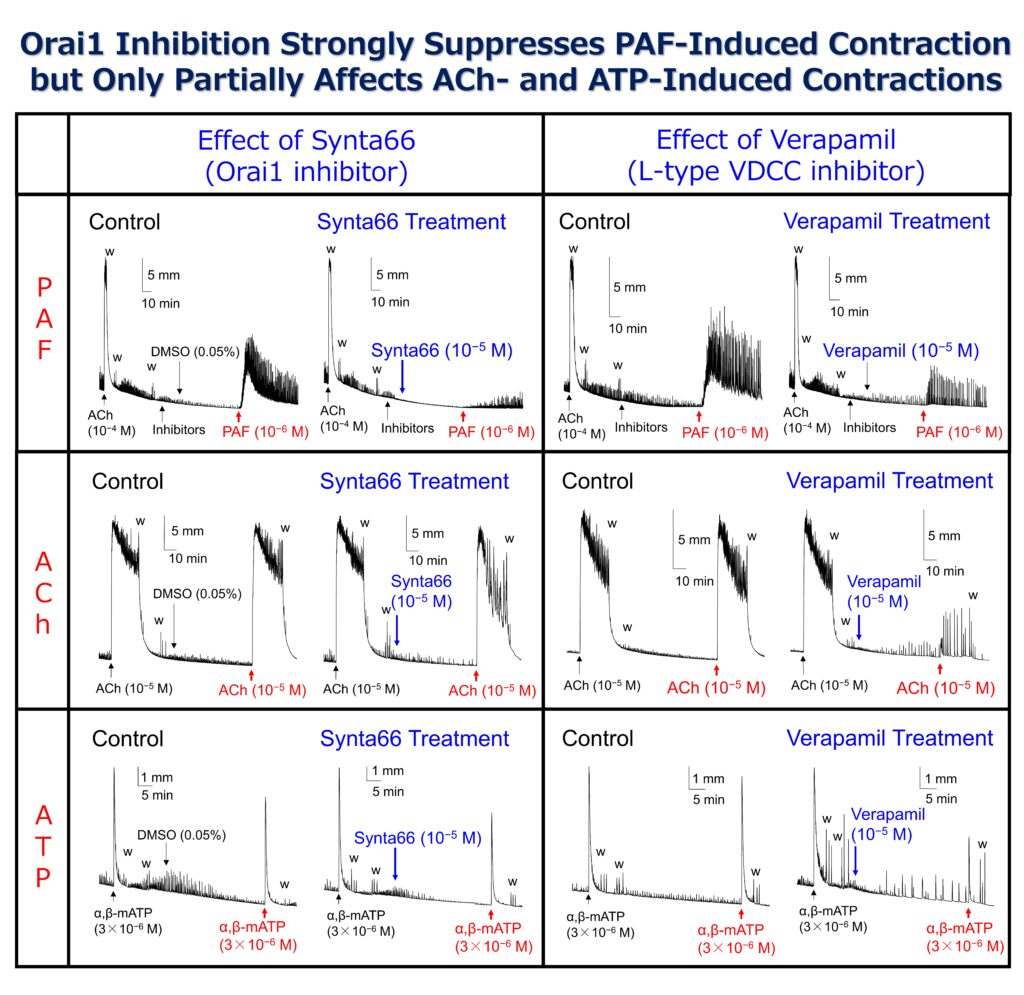
Application of PAF to isolated guinea pig urinary bladder smooth muscle produced a strong contraction, which was markedly suppressed by Synta66. PAF-induced contraction was also strongly inhibited by verapamil, an L-type VDCC inhibitor (Figure 1). These findings suggest that Orai1-mediated Ca2+ entry contributes to PAF-induced urinary bladder smooth muscle contraction in association with L-type VDCC-dependent contractile mechanisms.
The researchers also examined contractions induced by the re-addition of extracellular Ca2+ after depletion of intracellular Ca2+ stores, without directly stimulating PAF receptors. These contractions were strongly suppressed by both Synta66 and verapamil. Thus, the functional association between Orai1-mediated Ca2+ entry and VDCC-dependent contractile mechanisms may not be limited specifically to PAF receptor stimulation.
A particularly notable finding was that the contribution of Orai1 differed depending on the stimulus. Synta66 only partially suppressed contractions induced by ACh and ATP, major neurotransmitters involved in normal bladder function. In contrast, PAF-induced contraction was markedly suppressed by Synta66 (Figure 1). Moreover, Synta66 had no effect on contraction induced by a high concentration of potassium, which directly depolarizes the cell membrane and activates VDCCs.
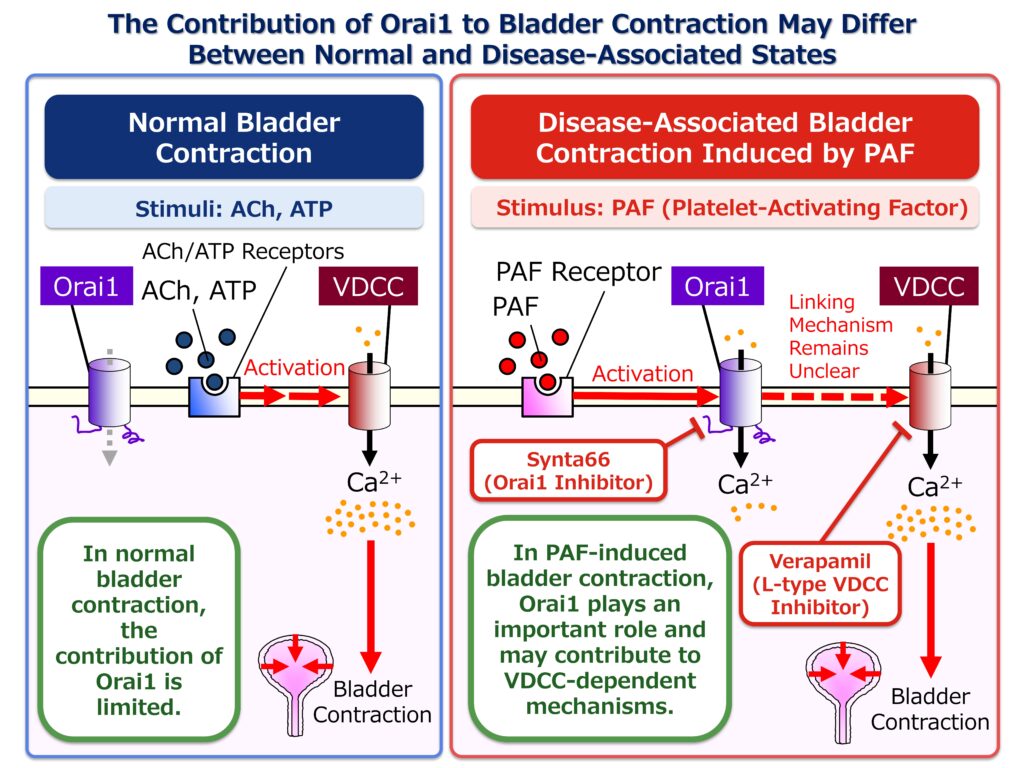
These findings suggest that Orai1 makes a relatively limited contribution to contractions evoked by neurotransmitters involved in normal bladder function, whereas it may play a greater role in PAF-induced contraction associated with inflammatory or other pathological conditions. Thus, the contribution of Orai1 to urinary bladder smooth muscle contraction may differ between normal and disease-associated states (Figure 2).
The researchers further examined several candidate molecules that might link Orai1-mediated Ca2+ entry to VDCC-dependent contraction, including the Na+/Ca2+ exchanger NCX1, TRPC1/4/5 channels, and the Ca2+-activated Cl− channel ANO1. However, pharmacological inhibition of these molecules did not significantly alter PAF-induced contraction. These results suggest that, under the present experimental conditions, these molecules are unlikely to constitute the major pathway linking Orai1 to VDCC-dependent mechanisms.
The present study does not directly establish how Orai1 and VDCC-dependent mechanisms are functionally linked. In addition, because the study did not use disease models of inflammatory bladder disorders, it does not directly demonstrate that the contribution of Orai1 increases under pathological conditions. Future studies directly examining membrane potential, channel activity, and intracellular Ca2+ levels, together with experiments using disease models, will be needed to clarify these mechanisms.
These findings provide new fundamental insight into the relationship between inflammatory lipid mediators and bladder function. A therapeutic approach that suppresses abnormal bladder contraction under pathological conditions while minimizing effects on normal bladder function would be desirable. If future studies using disease models confirm that Orai1 preferentially contributes to pathological bladder contraction, these findings could help clarify the mechanisms underlying bladder dysfunction associated with abnormal contraction, including overactive bladder, and support the development of new therapeutic approaches.

Journal:
Biological and Pharmaceutical Bulletin
Publish Date:
August 25, 2026
Volume and pages:
Vol. 49, No. 8, pp. 1298–1301
Article title:
Orai1 Contributes to Platelet-Activating Factor (PAF)-Induced Contraction in Association with Voltage-Dependent Ca2+ Channel-Mediated Mechanisms in Guinea Pig Urinary Bladder Smooth Muscle
Authors:
Keisuke Obara, Daiki Kato, Marina Yuguchi, Momoko Tanaka, Kento Yoshioka, Noritaka Nakamichi, Yoshio Tanaka
DOI:
10.1248/bpb.b26-00187
Article URL:
https://doi.org/10.1248/bpb.b26-00187
Notes
Note 1. Platelet-Activating Factor (PAF)
PAF is a bioactive lipid originally identified for its ability to activate platelets. It is produced by various cell types and is known to act as a lipid mediator involved in inflammation and allergic responses. PAF also acts on smooth muscle in various tissues and can induce contraction.
Note 2. Orai1
Orai1 is a Ca2+ channel located in the plasma membrane. When Ca2+ stores in the endoplasmic reticulum are depleted, Orai1 provides a major pathway for extracellular Ca2+ entry into the cell. It is one of the principal molecular components of store-operated Ca2+ entry.
Note 3. Voltage-Dependent Ca2+ Channels (VDCCs)
VDCCs open in response to changes in membrane potential and allow extracellular Ca2+ to enter cells. In smooth muscle, this Ca2+ influx plays an important role in triggering contraction. In this study, verapamil was used to inhibit L-type VDCCs.
Note 4. Synta66
Synta66 is a pharmacological inhibitor of Orai1-mediated Ca2+ entry. In this study, it was used to investigate the contribution of Orai1 to urinary bladder smooth muscle contraction.
Note 5. Store-Operated Ca2+ Entry (SOCE)
SOCE is a mechanism by which extracellular Ca2+ enters cells in response to depletion of Ca2+ stores in the endoplasmic reticulum. Orai1 is one of the principal channels responsible for this Ca2+ entry pathway.


Figure 1. PAF-Induced Bladder Contraction Is Strongly Suppressed by Orai1 Inhibition
Representative contractile traces of guinea pig urinary bladder smooth muscle are shown. Contractile responses were evaluated using the area under the curve (AUC) over a defined period after stimulation rather than the peak amplitude of transient contraction. The analysis periods were 60 min for PAF, 10 min for ACh, and 3 min for the ATP analog α,β-methylene ATP (α,β-mATP). PAF-induced contraction was strongly suppressed by both the Orai1 inhibitor Synta66 and the L-type VDCC inhibitor verapamil. In contrast, Synta66 only partially suppressed contractions induced by ACh and α,β-mATP, whereas verapamil strongly suppressed these responses. In the traces, “w” indicates washout. For experiments with PAF, an inhibitor cocktail was used to minimize the influence of endogenous neurotransmitters and allow the direct response to PAF to be evaluated. These findings suggest that although VDCCs are important for all of these contractile responses, Orai1 may play a greater role in PAF-induced contraction.


Figure 2. The Contribution of Orai1 to Bladder Contraction May Differ Between Normal and Disease-Associated States
During normal bladder contraction induced by ACh or ATP, Ca2+ influx through L-type VDCCs plays a major role, whereas the contribution of Orai1 appears to be limited. In contrast, Orai1 may play an important role in bladder contraction induced by PAF, a mediator involved in inflammation and allergic responses, and may be functionally associated with VDCC-dependent contractile mechanisms. Consistent with this interpretation, PAF-induced contraction was strongly suppressed by both the Orai1 inhibitor Synta66 and the L-type VDCC inhibitor verapamil. However, the molecular mechanism linking Orai1 to VDCC-dependent responses remains unclear.
RESEARCH
– News
– Guidelines & Policies
– Support Offices
– Facilities
– Security Export Control
Non-Degree Programs
– Clinical Elective Program
– International Physician Observership Program