Summary of the Research
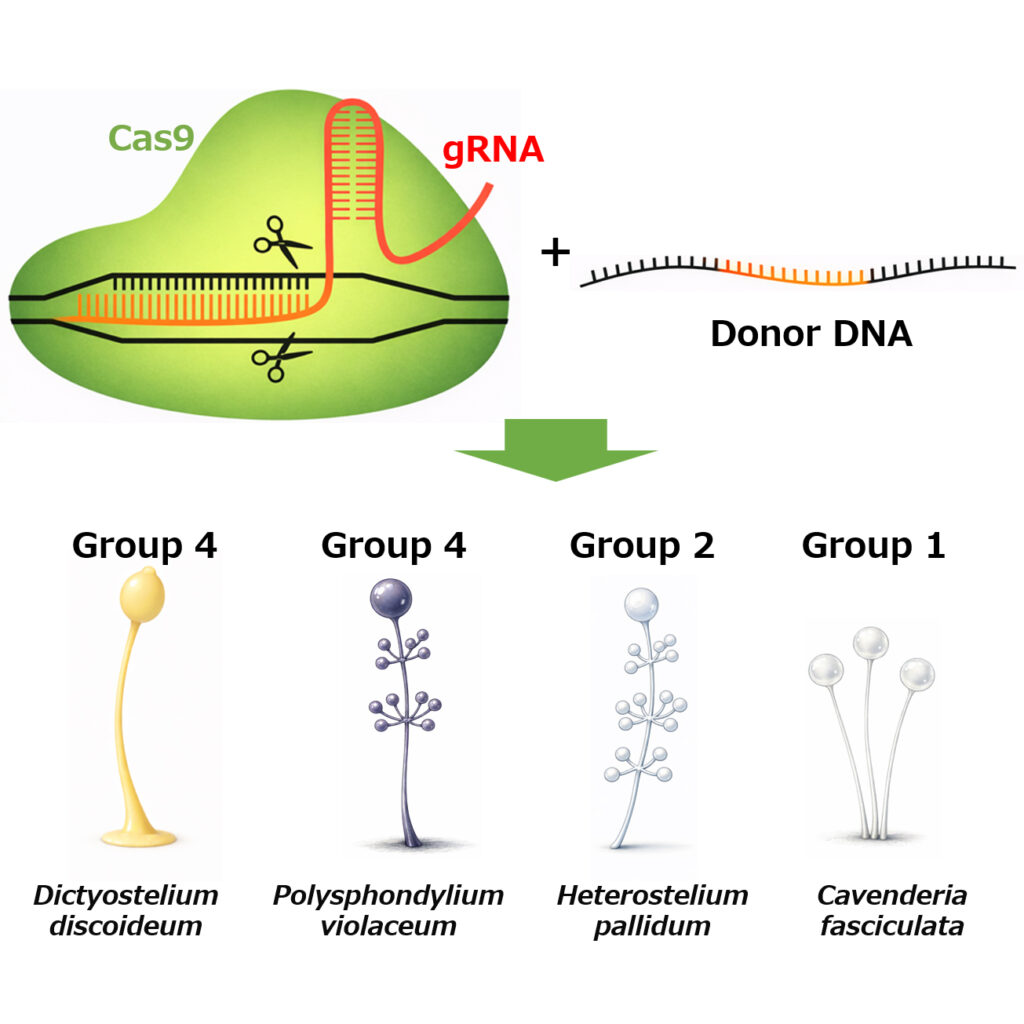
Multicellularity, the aggregation of unicellular organisms into multicellular structures, is a key biological phenomenon for understanding the evolution of life. Social amoebas, known as cellular slime molds, live as individual cells under normal conditions, but cooperate to form multicellular bodies when nutrients become scarce, making them excellent model organisms for studying multicellular development.
However, molecular genetic analyses have been largely limited to a single model species, Dictyostelium discoideum, making comparative studies across species difficult.
To address this limitation, the research group expanded genome editing methods for social amoebas. Using a CRISPR vector applicable to multiple species, they successfully achieved gene modifications in several Dictyostelia species, ranging from ancestral to more morphologically complex groups. Furthermore, the co-introduction of donor DNA greatly improved editing efficiency, enabling gene disruption in species that had previously been challenging to genetically manipulate.
This study establishes a research platform that enables cross-species comparisons of how unicellular organisms cooperate to form multicellular structures. This is expected to significantly advance our understanding of the evolution of multicellularity and coordinated cell behavior.
Journal:
Scientific Reports: February 5, 2026
Title:
Genome editing across Dictyostelia species enables comparative functional genetics of social amoebas
Author:
Shuka Oishi, Sousuke Doi, Takumi Sekida, Kensuke Yamashita, Yoko Yamada, Tetsuya Muramoto*
DOI:
10.1038/s41598-026-38605-5